A week ago this project was a folder of mockups and a long wish list. Today there is a working puzzle app with a new name, a wooden table to play on, and a lot less data than it started with. Here is where things stand.
Where we are
Jigsaw In My Pocket turns any photo on your phone into a jigsaw puzzle. You solve it at your own pace, and if you love it, the plan is that you can order the same picture as a real printed puzzle delivered to your door.
We are in the build phase. The web demo is live, and the recording below is me solving today’s puzzle in my phone’s browser. What does not exist yet is the installed iPhone and Android app, and the print-ordering service has not been switched on. Those are the two big steps between here and the app stores, and I would rather tell you that plainly than pretend we are further along.
What shipped since the start
The puzzle itself. Real interlocking piece shapes, cut fresh for every puzzle. A tray you can sort by edges or by colour. Hints that show you where a piece belongs. Zoom, a reference picture you can hide, and your progress saved automatically.
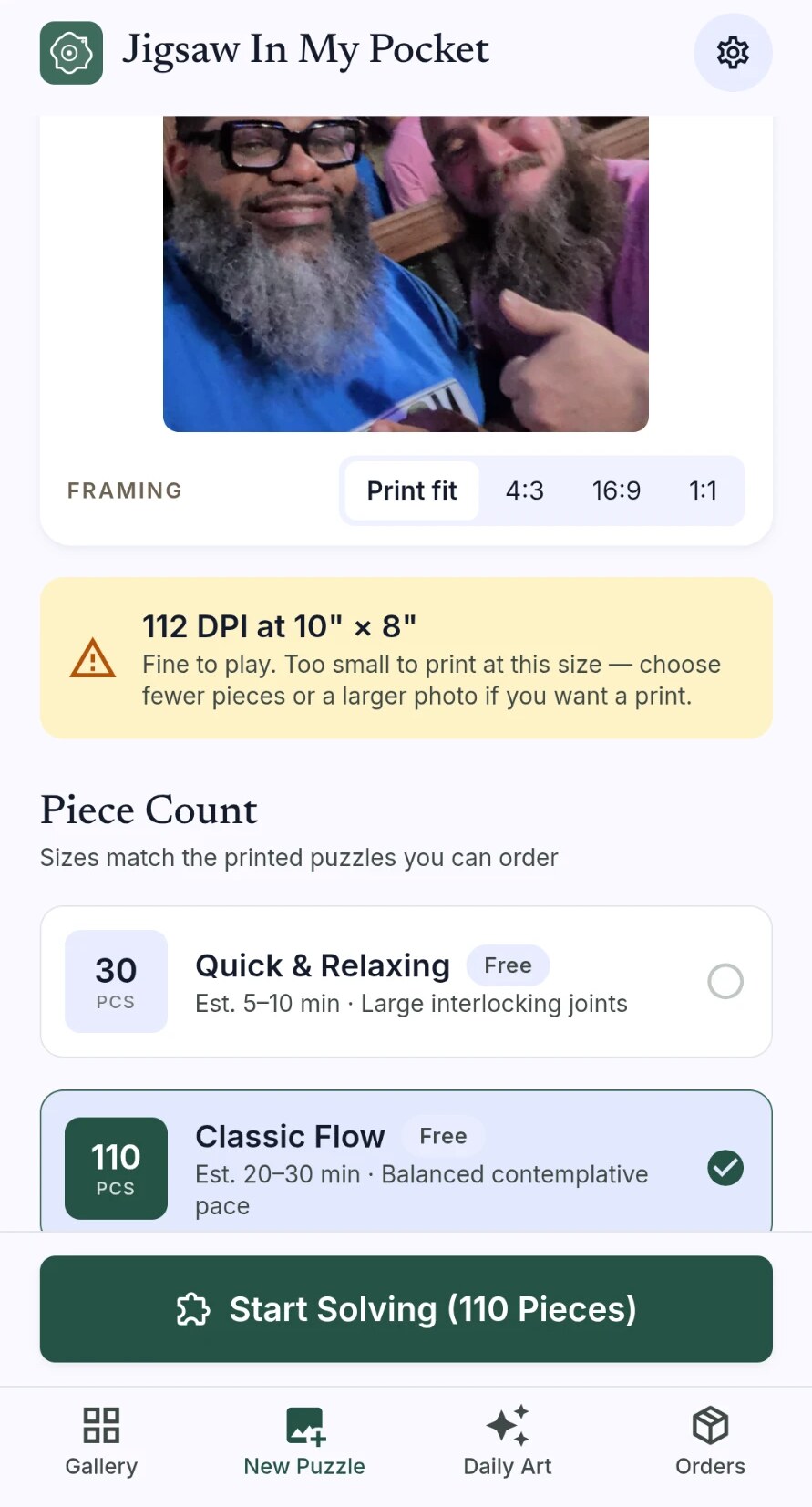

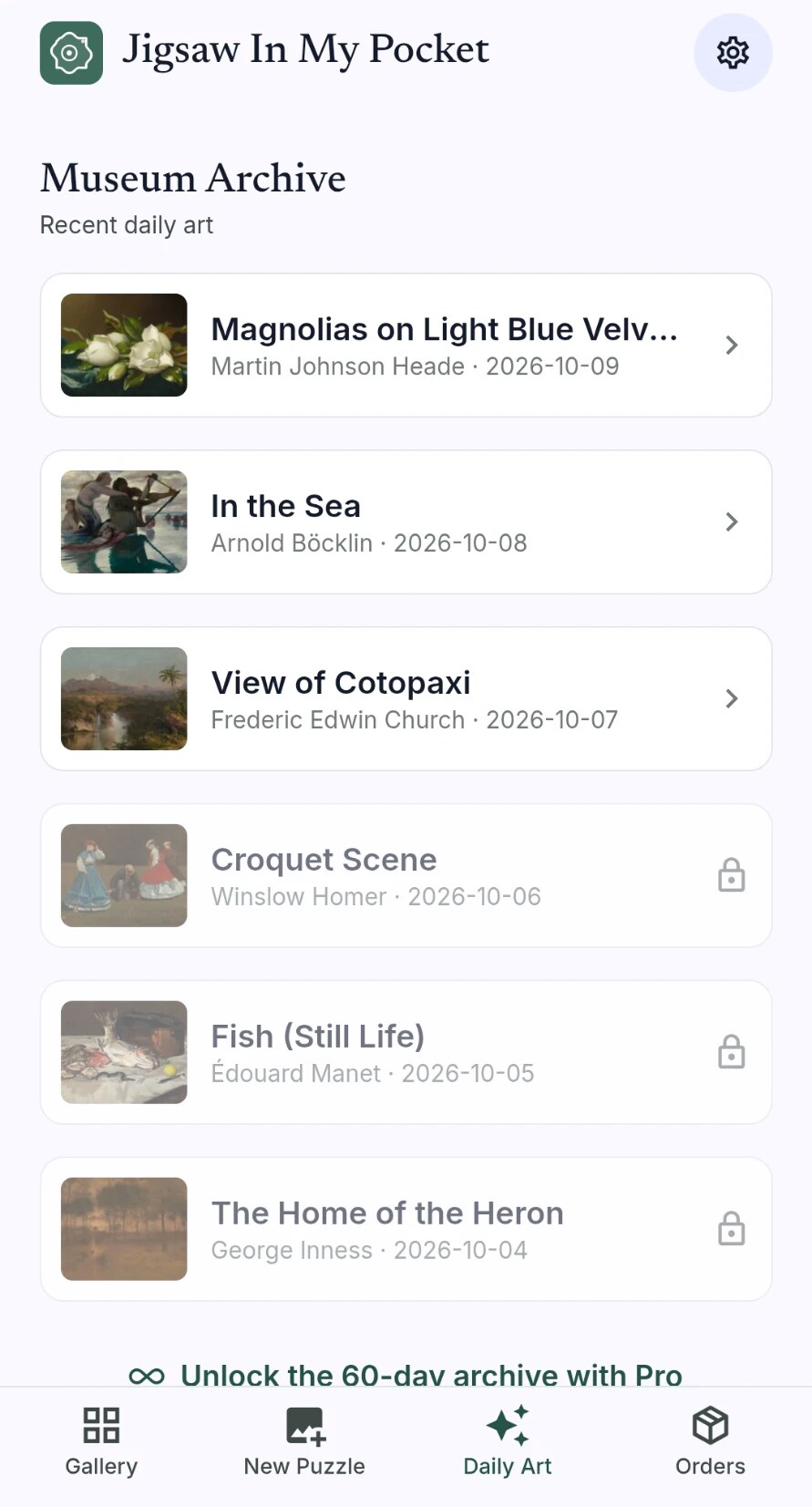
A daily masterpiece. Every day there is a new public-domain painting from a museum collection to solve, with a streak for showing up.
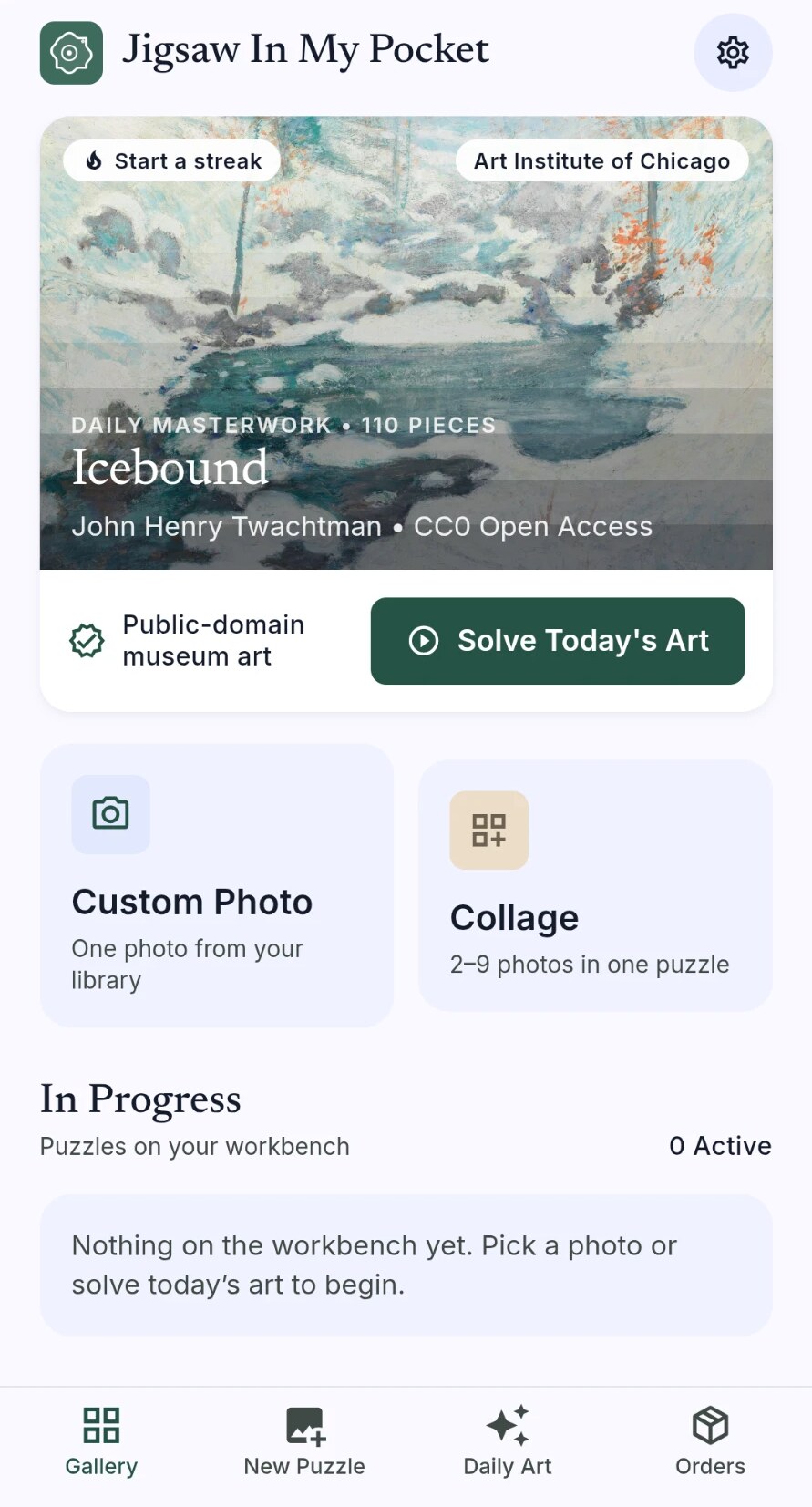
Collages. Combine two to nine photos into one puzzle.
A wooden table. The board now sits on a wood surface by default. Paper, linen, slate and felt are there if you prefer them.
A new name. The working title was Studio Jigsaw. It sounded like a design agency. Jigsaw In My Pocket says what it is.
Design decisions, and why
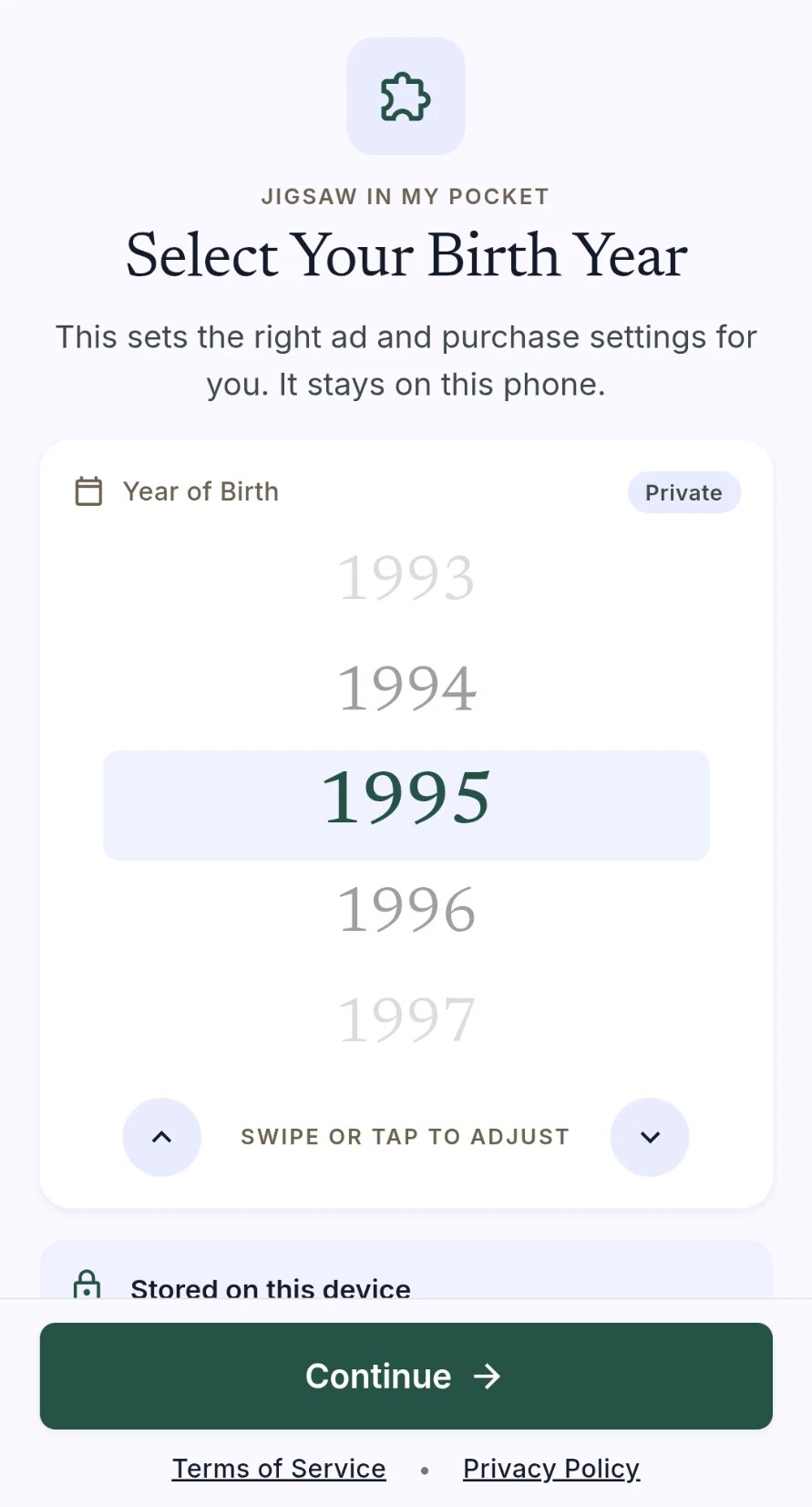
We deleted our own user database. The first version of the plan had what most apps have: a profile for every user, a record of what they unlocked, an option to link an email. None of that is needed to solve a puzzle, so it is gone. Your photos, your progress, your streak and even the birth year we ask for on first launch live only on your phone. There is no account and no sign-up.
The one moment a photo will leave your phone is when you order it as a print, because a printer cannot print what it cannot see. Even then, your name and address go straight to the payment company and the printer. We do not keep a copy. The photo is deleted 30 days after your puzzle is delivered.
Ads that do not follow you. The free version will have ads. They are never personalised, and the app will never show you that “allow tracking?” pop-up, because it never asks. This will earn less per ad. I am fine with that.
We cut gifting. The original plan let you send a puzzle to a friend with a link. It was a lovely idea, and it required us to store other people’s names, notes and photos on a server. That did not fit, so it is out of version one. Sharing now sends your time and piece count, never your photo.
Honest product copy. The early mockups promised wooden pieces, magnetic boxes and velvet bags. Our print partner makes a good, sturdy cardboard puzzle in a printed box. The app now describes that, and nothing more.
Fair pricing. Puzzles up to 110 pieces are free. Pro is planned at $3.99 a month or $24.99 a year, with no weekly plans.
A lesson learned. Privacy is much easier to design in than to bolt on. Removing the user database took a day because the app was a week old. In a year it would have taken a month.
What’s next
- Make it feel wonderful. Right now the app works, but it is quiet. Next comes the satisfying click when a piece snaps home, a proper moment when you finish, and your photo breaking apart into pieces when a puzzle begins.
- Put it on real phones as an app. Test builds for iPhone and Android, including a 1,000-piece stress test.
- Switch on printing. Connect the print and payment services and place a real test order to my own address.
- App Store and Google Play submission.
I am not going to put a date on launch until the installed app has been in my hand. Expect the next update when it has.
Privacy and AI note
Jigsaw In My Pocket has no accounts and no user database, and it never collects data to sell. The app was built with the help of AI tools; there are no AI features inside it, and your photos are never sent to an AI service.
Try it, follow along, tell me what you think
Try the web demo, take a look at the project page, and tell me one thing: which puzzle app has the most satisfying “snap” you have ever felt? Send me a note. It will shape what gets built next.
For the nerds
- One codebase for iOS, Android and web, built with Expo and React Native in TypeScript. The source is public on GitHub.
- The board is drawn with Skia. Each photo is cut once into a single sheet of pre-shaped pieces, and the whole puzzle is drawn in a handful of GPU calls. So far this is confirmed in browsers, including on my phone, not yet in the installed app.
- Puzzle state is stored on the device. The puzzle logic (piece shapes, snapping, print-resolution checks) and pricing are covered by automated tests.
- The backend is deliberately tiny: a table of daily museum artworks and a table of print order statuses. Prices are calculated on the server, and no secret keys ship in the app.
- Third parties: Stripe for print payments, Printify for printing, RevenueCat for the Pro subscription, Google AdMob for non-personalised ads on the free tier, Supabase for hosting.